
Online European Roulette in the UK: Rules and Play
 Available in GB
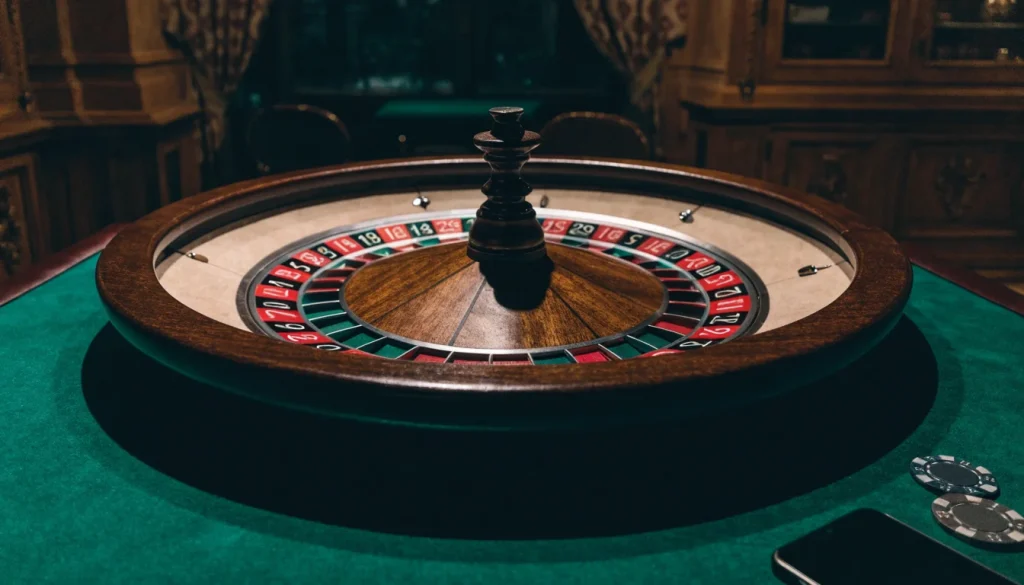
See how the single-zero wheel, table layout, bet types and game formats shape European roulette.
European Roulette: One Zero, 37 Pockets
European roulette is defined by its wheel: it has pockets numbered from one to thirty-six, plus a single zero. That makes thirty-seven possible landing places. When you see the game offered by an online casino, this pocket count is the first detail to check; the word “European” refers to a particular roulette format, not simply to a casino’s location or the appearance of its screen.
The zero is the feature that gives the wheel its familiar single-zero structure. It is a distinct outcome, rather than another numbered pocket, and it matters to the game’s mathematics. The numbered outcomes are not the whole set of possibilities: the green zero also has a place on the wheel. Any description of European roulette that leaves it out is describing an incomplete version of the game.
A roulette spin produces one result: the ball comes to rest in a pocket. Before that happens, a player may select an outcome or a group of outcomes on the betting layout. The wheel’s result determines whether that selection wins or loses. The layout and the wheel work together, but they are not the same thing: the layout organises the available selections, while the wheel supplies the result. The details of where selections sit and how individual wagers pay are separate matters.
When choosing an online European roulette option in the UK, payout timing is one practical detail to check. Use the verdicts below as a quick reference.
1. EvoSpin
Payout speed: 1-3 business days
EvoSpin lists a payout speed of 1–3 business days, a useful detail to consider when you plan your withdrawals.
2. Revery Play
Payout speed: 1-3 business days
Revery Play lists a payout speed of 1–3 business days, which gives you a stated timeframe to keep in mind for withdrawals.
3. WinBeast
Payout speed: 1-3 business days
WinBeast lists a payout speed of 1–3 business days. Consider this stated timeframe when weighing your roulette options.
4. Zombillion
Payout speed: 1-3 business days
Zombillion lists a payout speed of 1–3 business days, giving you a clear detail to factor into your choice.
5. BeOnBet
Payout speed: 1-3 business days
BeOnBet lists a payout speed of 1–3 business days, which may help you assess whether its withdrawal timing suits you.
6. Dieselwin
Payout speed: 1-3 business days
Dieselwin lists a payout speed of 1–3 business days. Keep this stated timeframe in mind when considering your options.
7. Jetsetspins
Payout speed: 1-3 business days
Jetsetspins lists a payout speed of 1–3 business days, a practical point to consider alongside your roulette preferences.
8. NightWin
Payout speed: 1-3 business days
NightWin lists a payout speed of 1–3 business days, giving you a stated withdrawal timeframe to note.
9. Chanze
Payout speed: 1-3 business days
Chanze lists a payout speed of 1–3 business days. This stated timing can help you decide whether it fits your needs.
10. SpinFormula
Payout speed: 1-3 business days
SpinFormula lists a payout speed of 1–3 business days, which you can factor into your choice of an online roulette option.
The pocket count also explains why European roulette is not a game in which every possible result has the same meaning for a player. A wager may cover a narrow or broad set of outcomes, but the wheel still has the same thirty-seven pockets. The zero remains among them regardless of which selection is made. In other words, covering more numbers does not remove the zero from the game or change the wheel’s composition.
That fixed composition underpins the standard house edge for European roulette: 2.70%. The house edge is a theoretical measure of the casino’s advantage across play over time, not a prediction of what will happen in a particular session. It does not mean that a casino takes a fixed share from every spin, nor does it say whether an individual player will win or lose. Short runs can produce results that differ sharply from the long-run expectation. The figure describes the structure of the game, not a promise about any one outcome.
For a reader comparing online versions, the key question at this stage is whether the game actually uses the European single-zero wheel. A screen may show a roulette table and numbered spaces, but visual presentation alone does not establish the variant. Look for the stated game name and the pocket configuration. If the game has numbers from one to thirty-six and one zero, it matches the defining European wheel. If the configuration differs, its probabilities and house edge may differ too.
Online Casino Tournaments UK: Free Entry Explained · Mines Casino Game in the UK: What to Know
This distinction is more useful than relying on a broad label such as “roulette”. The same general game can be presented in formats with different wheel structures, and the number of pockets affects the chance of a particular pocket being selected. European roulette’s single zero is therefore not a decorative detail. It is part of the reason its standard house edge is 2.70%, and it gives you a clear baseline for understanding other roulette variants.
The word “online” changes how you access the game, not what defines the European wheel. Whether the game appears as a digital table or as part of a casino’s roulette selection, its defining feature remains the single-zero set of pockets. That is the point to keep in view when a page uses broad claims about European roulette: the format is identified by its wheel, while the mathematical edge follows from the available outcomes and the game’s rules.
It is also worth separating a theoretical edge from the idea of a reliable pattern. Each spin ends in one pocket, and earlier results do not alter the wheel’s listed possibilities for the next one. A run of one colour, number group or other result does not make a different outcome due simply because it has not appeared recently. The wheel provides no memory to consult. The useful comparison is structural: pocket count, zero arrangement and the stated house edge.
European Roulette Basics
European roulette features 37 pockets (1-36 and a single zero) and carries a standard house edge of 2.70%.
For European roulette, that comparison begins with a simple specification: thirty-seven pockets, including one zero, and a standard house edge of 2.70%. Keep those details in mind when you encounter an online roulette game presented under a different name or format. One zero, thirty-seven pockets.
Choosing a UK Casino by the Criteria That Matter
The best European roulette casino for you depends on what you are comparing. A useful shortlist starts with three checks: whether the game is actually available, whether its return information is easy to find, and whether the operator’s regulatory status and player protections stand up to scrutiny. A polished lobby is not a substitute for any of them.
Confirm that European roulette is available
Search the casino’s game library for European roulette, then check the game information before opening an account. A casino may offer roulette without offering this particular version; a roulette-themed slot is also a different product from a table game played on a European wheel. If the distinction is unclear, look for the rules or help panel attached to the game rather than relying on a thumbnail or promotional description.
Availability can depend on the format offered, too. The casino’s listing should make clear which game you are opening and provide access to its rules. That gives you a practical basis for comparison without assuming that every title labelled “roulette” follows the same rules. If the game is difficult to locate or its description leaves basic details unanswered, that is useful information about the casino’s presentation.
French Roulette Online Casinos in the UK: Rules & Play
Look for accessible RTP information
RTP, or return to player, describes a game’s theoretical return over extended play; it is not a forecast of what you will receive in a particular session. Before comparing casinos, see whether the relevant game’s RTP information is available from the game screen, its rules, or a clearly signposted help page. The figure should be associated with the specific game, not buried in general casino wording that leaves you unsure which version it describes.
Accessibility matters as much as the presence of a number. You should be able to find the information before committing funds, and the casino should make the rules readable rather than turning a basic check into a search through unrelated pages. If RTP or game rules are absent, unclear, or difficult to match to the table, do not fill the gap with an assumption. A casino that presents the information plainly is easier to assess.
Check the licence and the protections attached to it
For British players, real-money online casino activity is regulated by the UK Gambling Commission (UKGC), the sole regulator of online casino activity in Great Britain. Remote operators selling into the British market must hold the relevant UKGC licence, wherever they are based. Online gambling is legal in the UK only through licensed and regulated sites, so verify the operator’s licence number on the UKGC public register before depositing. A platform without a valid UKGC licence cannot legally offer real-money live roulette to British residents.
Licence Warning
A platform without a valid UKGC licence cannot legally offer real-money live roulette to British residents; always verify the licence number on the public register before depositing.
A licence is a starting point, not a reason to skip the practical checks. UKGC-licensed operators must provide account tools that let you set and manage financial limits. New customers must be prompted to set a financial limit before their first deposit, and account-level controls should remain accessible. Operators must verify your age before allowing you to deposit. They must also provide responsible gambling tools, including self-exclusion; live casino operators must offer deposit and loss limits, session time reminders, reality checks, cool-off periods and GamStop self-exclusion.
Check how to raise a complaint as well. UKGC licensees must have an internal complaints process and provide access to an approved Alternative Dispute Resolution service. They are also required to contribute to the Research, Education and Treatment levy. These obligations do not tell you whether you will enjoy a particular table, but they do give you concrete standards against which to assess the operator.
Compare by the criterion you care about
A simple comparison table can keep the decision grounded:
| Criterion | What to verify |
|---|---|
| Game availability | European roulette is listed, with rules attached to the specific game |
| Information | RTP and game rules are accessible before you play |
| Regulatory status | The UKGC licence appears on the public register |
| Player protection | Limits, reminders, self-exclusion and complaints routes are explained |
The stronger choice depends on your priority: clear game information, easy-to-find account controls, or confidence that the operator is properly regulated. No single casino is automatically best on every measure. The comparison is only useful when the criteria are visible.
How to Play: Bets and Payouts
To play European roulette online, choose a table and select the amount you want to stake. The betting screen shows a numbered grid and separate areas for other bet types. Click or tap a chip value, then select the number or betting area you want. You can place several bets before the betting period closes; check the displayed stakes before confirming, as each selection adds to the total wager.
A bet can cover one number or a group of outcomes. Inside bets sit on specific numbers or combinations on the grid. Outside bets cover broader categories, such as a colour or whether the result is odd or even. The choice changes both how many results can win and the payout odds. A broader bet covers more outcomes, while a narrower one pays more if it wins.
| Bet | What it covers | Payout |
|---|---|---|
| Straight-up | One number | 35:1 |
| Split | Two adjacent numbers | 17:1 |
| Street | A horizontal row of three numbers | 11:1 |
| Red or black | One of the two colours | 1:1 |
| Even or odd | One of the two number groups | 1:1 |
| High or low | One of the two number ranges | 1:1 |
The ratio is the amount paid in winnings in relation to the stake; the original stake is returned on a winning bet. So a straight-up wager pays more than an outside bet because it targets a single result rather than a larger set. A split covers a pair of neighbouring numbers, while a street covers three numbers arranged in a horizontal row. These are different ways to define what counts as a win, not different ways to predict the result.
Red and black, even and odd, and high and low are commonly called even-money bets because they pay 1:1. They are straightforward to read: choose the category shown on the table, and the bet wins if the result belongs to it. The categories do not cover every possible result, so read the table’s rules and layout rather than assuming that every spin must fit one of the choices.
After placing your selections, review the chips on the table and the total stake shown on screen. Remove or change a bet before the betting window closes if the displayed amount is not what you intended. Once the spin is underway, the result determines which selections win; the payout is calculated according to each winning bet’s odds. If you have several bets on the same spin, each is settled separately.
Straight-up Bet
Example: 35:1 × £1 = £35 winnings (plus the £1 stake returned).
For a first game, keeping the wager simple makes the result easier to follow. A single outside bet shows how a broad category settles; a straight-up bet makes the higher payout and narrower coverage clear. You can also practise in a free-play mode where one is offered, but it does not make a winning selection more likely. The useful comparison is the bet’s coverage against its payout—not the appearance of a larger return on the screen.
The Wheel, RNG Spins and Table Pace
A European roulette wheel can be understood in two ways online: as a physical object that produces the result, or as a game whose software simulates the spin. The distinction affects what you see and how quickly rounds can move, but it does not turn chance into a pattern you can read.
On a physical European wheel, the ball travels around a circular track before dropping into a pocket. The wheel has 37 pockets, numbered from 1 to 36 with a single green zero. Online RNG roulette does not need a wheel or ball for each round. Instead, a random number generator selects an outcome, and the game presents it as a roulette result. The animation may show a spinning wheel, but that visual does not mean a physical wheel produced the number.
The practical comparison is therefore about format, not appearance. A simulated wheel can give you a familiar visual while the underlying result comes from software. If you prefer to see an actual wheel and ball determine each outcome, an RNG game is not the same experience, even when its graphics look convincing. If you value a quicker round and a lower entry point, RNG roulette may suit you better: it can move faster than a standard table, and minimum stakes can be as low as 10p.
Appearance is not mechanism.
Mechanism vs Appearance
A spinning wheel animation in an RNG game is a visual representation; the actual result is determined by random number generator software, not a physical ball drop.
Pace deserves its own comparison. A standard roulette table is reported at 80–100 spins per hour. Speed roulette can run at more than 150 spins per hour, according to a specialist review. Treat those figures as a format comparison, not a promise about every game: the actual pace depends on the game and how quickly you make decisions. Faster rounds leave less time between outcomes, so a small stake can still be exposed to more successive spins in a session.
RNG roulette is also generally faster than a physical-wheel format because the software can move directly from one completed round to the next, without waiting for a ball to travel and settle. That does not make the result more predictable. Each spin remains a separate random outcome; a sequence of previous results does not tell you what the next one will be.
When comparing online casinos with European roulette, separate the wheel shown on screen from the method that determines the result. Look for the game’s stated format before you start: a wheel animation may be part of RNG software, while a physical wheel indicates a different mode of play. Then compare pace by asking whether you want time between rounds or a more continuous sequence. Neither is automatically better. The right fit depends on whether visual realism or quick, low-stake play matters more to you.
Online Casino Without ID in the UK: Checks Explained
A European roulette casino wheel and its digital counterpart share the same familiar single-zero identity, but not the same process. The physical wheel relies on a ball settling into a pocket; an RNG title uses a random number generator and may depict that process on screen. For a slower rhythm, the standard-table pace is the clearer reference. For more rounds in less time, speed roulette is the faster format. Your choice changes the session’s tempo, not your ability to forecast the result.
Single-Zero Bets, La Partage and Betting Systems
On a European roulette single-zero wheel, the green zero is the complication for even-money choices such as red or black. Those bets cover many numbered outcomes, but zero is neither red nor black. Without a special rule, it can make an otherwise successful-looking run less favourable than the simple win-or-lose pattern suggests: the standard house edge is 2.70%.
La Partage changes what happens when the ball lands on zero. Instead of losing the entire even-money stake, you receive half of it back. On those bets, this rule reduces the house edge to 1.35%. It does not remove the house advantage, and it applies to even-money bets rather than every option on the table.
That makes La Partage a rule-based change to the wager’s terms. If you are comparing betting options, it matters specifically when you plan to bet on an even-money outcome. It does not make a particular colour more likely to appear, and it is not a method for recovering losses. The distinction is important: a rule can alter the cost of a bet, while a staking plan only changes how much you risk from one spin to another.
Staking Risks
Betting systems like Martingale do not change the odds of the game and can lead to rapid bankroll depletion during a losing streak.
What a staking system can—and cannot—do
Martingale is a familiar staking system: after each loss, you double the next bet. The idea is to make a later win large enough to offset earlier losses. But the system does not change the roulette odds or predict where the ball will land. Every result remains a matter of chance.
The practical risk is the sequence of losses before a win. Each doubling requires a larger stake, so a losing streak can put serious pressure on your bankroll. A system that appears manageable at the start may become difficult to sustain as the required bets grow. A win may interrupt the sequence, but it cannot be scheduled.
This is why a betting system should not be mistaken for an advantage. Martingale changes the size of your next wager; La Partage changes the settlement of a specific kind of wager when zero appears. Only the latter reduces the house edge on the relevant even-money bets. Neither offers a way to know the next result.
Choose by the rule, not the story
If you prefer even-money bets, the useful comparison is whether the table applies La Partage, not whether a betting pattern sounds reliable. If you choose another type of bet, check its own rules rather than assuming the half-refund applies across the layout. The rule is narrow by design.
Set a stake that remains comfortable even if several results go against you. That matters especially if you are considering Martingale, because doubling after each loss can escalate exposure quickly. A smaller starting bet does not make the sequence predictable; it only changes the amounts involved.
Online Bingo UK: How Rooms, Tickets and Slots Work
The better choice depends on what you value: La Partage lowers the house edge for eligible bets, while a staking system provides no change to the underlying odds. Roulette strategies cannot predict the final outcome. Chance remains in charge.
Free Play, Real Money and Bonus Terms
A free-play European roulette table lets you explore the interface and place bets without staking cash. It can help you see how the game works, but it does not produce withdrawable winnings. Real-money play uses funds in your gambling account, so the balance can rise or fall with the results. Choose between them by purpose: a demo is for trying the format, while cash play carries financial risk.
Before depositing, remember that UK rules require the operator to verify your age, and you must be at least 18 to gamble online legally. New customers must be prompted to set a financial limit before their first deposit; account-level controls must also be accessible so you can adjust limits later. These are practical safeguards, not a reason to deposit more.
Funding rules matter too. UKGC-licensed operators cannot accept credit cards for gambling, including credit-card funds routed through a money service business. They also cannot take wallet payments if the wallet allows credit-card funds to be used for gambling. Check the payment method’s source of funds rather than assuming a wallet makes a prohibited card payment acceptable.
Do
- Verify age and set financial limits before first deposit
- Check game-weighting rates in bonus terms
- Use UKGC-licensed operators
Don’t
- Use credit cards for gambling deposits
- Assume a bonus applies equally to all roulette formats
- Ignore wagering requirements before opting in
Bonus terms add another comparison. Most UK operators count roulette wagers at 10% to 20% of wagering requirements, but the rate depends on the operator and the game format. A specialist review reports that live roulette may count at 10% or 20%, while RNG roulette may count at 100%; treat those as reported examples, not a rule for every account. Read the promotion’s terms before opting in, and check whether roulette is eligible at all. A low game-weighting rate means roulette wagers do less to clear a wagering requirement than games with a higher rate.
A separate specialist review reports that, from January 2026, UK regulations cap bonus wagering requirements at 10 times the bonus amount for licensed operators. Since individual offers can still differ in eligibility and game weighting, the headline cap does not tell you how much roulette play will count. The terms decide that.
For a clean comparison, note the bonus amount, wagering requirement, eligible roulette format, game-weighting rate and any withdrawal conditions. Then compare the offer with playing without bonus funds: a promotion is useful only if its conditions suit the way you intend to play. A demo avoids those conditions altogether, while real-money play means your own balance is at stake. Keep the distinction clear.
Reading the European Roulette Table Layout
A European roulette table layout is arranged to make two kinds of selection visible: individual numbers in the central grid and broader groups in the areas around it. The grid represents the wheel’s 37 pockets: numbers 1 to 36 and a single zero. The layout is not a picture of the wheel’s physical order. It is a betting map, with numbers arranged in three vertical columns and twelve horizontal rows.
Live Dream Catcher Casino UK: How the Game Works
Each number has its own betting position, often called a box. The zero sits apart from the main grid, in a green area at one end. That separation is useful when you scan the table: the numbered field contains the red and black pockets, while green marks the zero. The colours help distinguish sections, but they do not change where a bet is placed or how the result is determined.
Around the numbered field, markings identify bets that cover groups rather than one number. The spaces beside the grid correspond to the vertical columns. Other marked areas run along its outer edges, where you can select a dozen or a broad range of numbers. Further out are the familiar even-money choices, such as red or black, odd or even, and low or high. Their placement gives you a quick visual route from a narrow selection in the centre to a wider one at the edge.
Some bets sit on boundaries rather than inside a number’s box. A chip placed at a shared corner or line can cover adjacent numbers, so its exact position matters. Online tables commonly show a marker or highlight for the selected area; check that it lands on the intended line before confirming. A small movement can change the selection.
A simple way to read the grid
Start with the zero, then trace the three-number rows across the central field. From there, look outward: the column labels sit alongside the grid, while the broader group and even-money options occupy the surrounding bands. This makes the table easier to read without memorising every betting position.
Table Layout Check
- Identify the zero’s position
- Confirm the chip is placed correctly on the line or box
- Verify the total stake shown on screen
- Check that the selection matches the intended bet type
The layout also helps you distinguish bet selection from roulette strategy. It shows which numbers or groups a chip covers; it cannot indicate what the next result will be. A clear view of the grid is useful for avoiding placement mistakes, not for predicting the ball.
On a digital table, the same structure may be compressed to fit a screen. If labels are small, enlarge the view or inspect the selected area before the spin begins. The key is the chip’s location, not the speed of your click.
Roulette-Themed Slots and Lightning Features
A roulette image on a screen does not make the game roulette. A slot may borrow the wheel, numbers, colours or casino-floor atmosphere, but its outcome is generated under slot rules rather than by a ball landing in a pocket. The distinction matters if you are comparing European roulette odds: a themed slot does not use the European wheel’s betting structure simply because its artwork does.
Names such as 3D European Roulette or European Roulette Gold can describe a slot’s presentation or branding. They do not, by themselves, confirm a single-zero wheel, roulette-style bets or roulette payouts. The same applies to a title using “Platinum”. Check the game’s rules and paytable to see what determines wins. If the game has reels, symbols and a slot paytable, treat it as a slot; if it offers bets on a wheel outcome, it is roulette.
Online slot payout percentages and how RTP works
Lightning Roulette shows a different distinction: it is a roulette variant, not merely a slot with roulette graphics. Its special feature can change the return on a straight-up number bet. A specialist review reports that a straight-up bet without a lightning multiplier pays 29:1 rather than the 35:1 associated with standard roulette. That detail is specific to the named game and its rules, so check the table information before playing. The same review reports that outside bets retain standard roulette payouts. A feature can alter one part of the bet structure without changing every bet.
UK rules for roulette-themed slots
Online slots are subject to rules that do not apply in the same way to a roulette table. In Britain, a slot spin must last at least 2.5 seconds, and autoplay is banned. The maximum stake per game cycle is £5 for customers aged 25 and over, and £2 for those aged 18 to 24. These limits concern online slots, not roulette bets.
For real-money play, use a UKGC-licensed operator. The operator must verify your age before allowing you to deposit, and remote operators must prompt new customers to set a financial limit before their first deposit while providing accessible account-level limit controls. A slot’s casino styling does not change which rules apply: classify the game by how it works, then check its own rules and the operator’s terms. A roulette label is not a rulebook.
Slot vs Roulette
Roulette-themed slots use slot rules and paytables, not the European wheel’s betting structure, regardless of the artwork used.
Live European Roulette with a Dealer
A live European roulette table puts a physical wheel on screen rather than generating each result through software. A studio camera streams the wheel, a human dealer releases the ball, and you watch it land in a numbered pocket. The result is produced by the real ball drop, while the betting interface lets you place wagers remotely.
That format suits you if seeing the wheel and dealer matters more than keeping play entirely automated. The trade-off is that the stream follows the dealer’s game, so it does not offer the same pace as a purely digital table. The camera view also matters: you should be able to follow the wheel and the result clearly, not just see an animated table overlay.
Table minimums depend on the game and operator. A specialist review reports that some UK live roulette tables start at 10p, while auto-roulette and speed formats can start at 5p. Treat those figures as reported low-end examples, not a promise that every table will offer them. Check the minimum shown in the game before joining; it is the relevant figure for your session.
The provider’s live studio does not replace the operator’s legal responsibilities. A platform without a valid UK Gambling Commission licence cannot legally offer real-money live roulette to British residents. Check the operator’s licence number on the UKGC public register before depositing. The operator must verify your age before allowing a deposit, and UKGC-licensed live casino operators must provide deposit and loss limits, session time reminders, reality checks, cool-off periods and GamStop self-exclusion.
These tools are useful only if you can find and set them. Remote operators must prompt new customers to set a financial limit before their first deposit and provide accessible account-level limit controls. If a dispute arises, a UKGC licensee must offer an internal complaints process and access to an approved Alternative Dispute Resolution service.
Chicken Road Casino UK: Game and Offer Checks
For a live table, compare the stream’s clarity, the displayed minimum and the ease of accessing these safeguards. A polished studio is not a substitute for a valid licence or usable account controls. Verify both before play.
European vs American Roulette: The Extra Zero
The clearest difference between European and American roulette is the number of green pockets. A European wheel has numbers from 1 to 36 and one zero, making 37 pockets in total. The American version adds a double zero, giving it 38 pockets. That extra outcome changes the odds against the player.
On a standard European table, the house edge is 2.70%. On an American table with a single zero and a double zero, it is 5.26%. The wheel has not changed the familiar red, black, numbered and outside-bet categories; it has added another result that can make those wagers lose. If you are comparing the two formats by house edge, European roulette is the lower-edge choice.
Keno Online Casinos in the UK: Games and Odds
Some American roulette tables available through UK online casinos may have another green pocket marked 000. A specialist review reports a version with this third green pocket and a house edge of 7.69%. Treat that as a specific table configuration, not a feature of every American game. Check the displayed rules and wheel before you play: the label “American roulette” alone does not tell you whether a table includes 000.
The practical comparison is straightforward. European roulette has fewer pockets and a lower house edge than standard American roulette; an American table with 000 has a higher edge still. The extra green pocket is the deciding detail, not a cosmetic change to the layout.
This does not make European roulette a way to predict results or secure a return. Each spin remains a game of chance. If you want the lower house edge, choose the European format; if you select American roulette, confirm whether the table uses two or three green pockets. The better fit depends on the format you want, but the edge comparison favours the single-zero wheel.
Should I play American or European roulette if I’m in the UK?
European roulette has the lower house edge: 2.70%, compared with 5.26% for American roulette. Check the wheel layout, since some American tables include a third green pocket marked 000.
How does roulette actually work?
You place a wager on an outcome or group of outcomes, then the ball lands in one pocket on the wheel. Whether your wager wins depends on whether it covers that result; each spin is determined by chance.
What are inside and outside roulette wagers?
Inside wagers cover specific numbers or small groups, such as a straight-up bet on one number, a split on two adjacent numbers, or a street on three numbers. Outside wagers cover broader outcomes such as red or black, even or odd, and high or low; these pay 1:1.
How does the 10x wagering cap affect roulette bonuses?
Since January 2026, UK-licensed operators can set bonus wagering requirements at no more than 10x. Roulette may contribute only 10% to 20% of wagering at some operators, while RNG roulette may count at 100%, so check the game’s contribution rate in the bonus terms.
Casino Games
Created by the "Vegas Hero Casino" editorial team.